Custom Fragrance Development, Stage by Stage: What Happens and When
Custom fragrance development follows a predictable sequence: brief, direction, sample iterations, selection, stability and compatibility testing, packaging approval, pilot run, then bulk. The sequence matters less than the decision gates inside it, because each gate holds a decision the brand has to make and each one consumes calendar time. Projects that miss a launch date have usually missed a gate, not a machine.
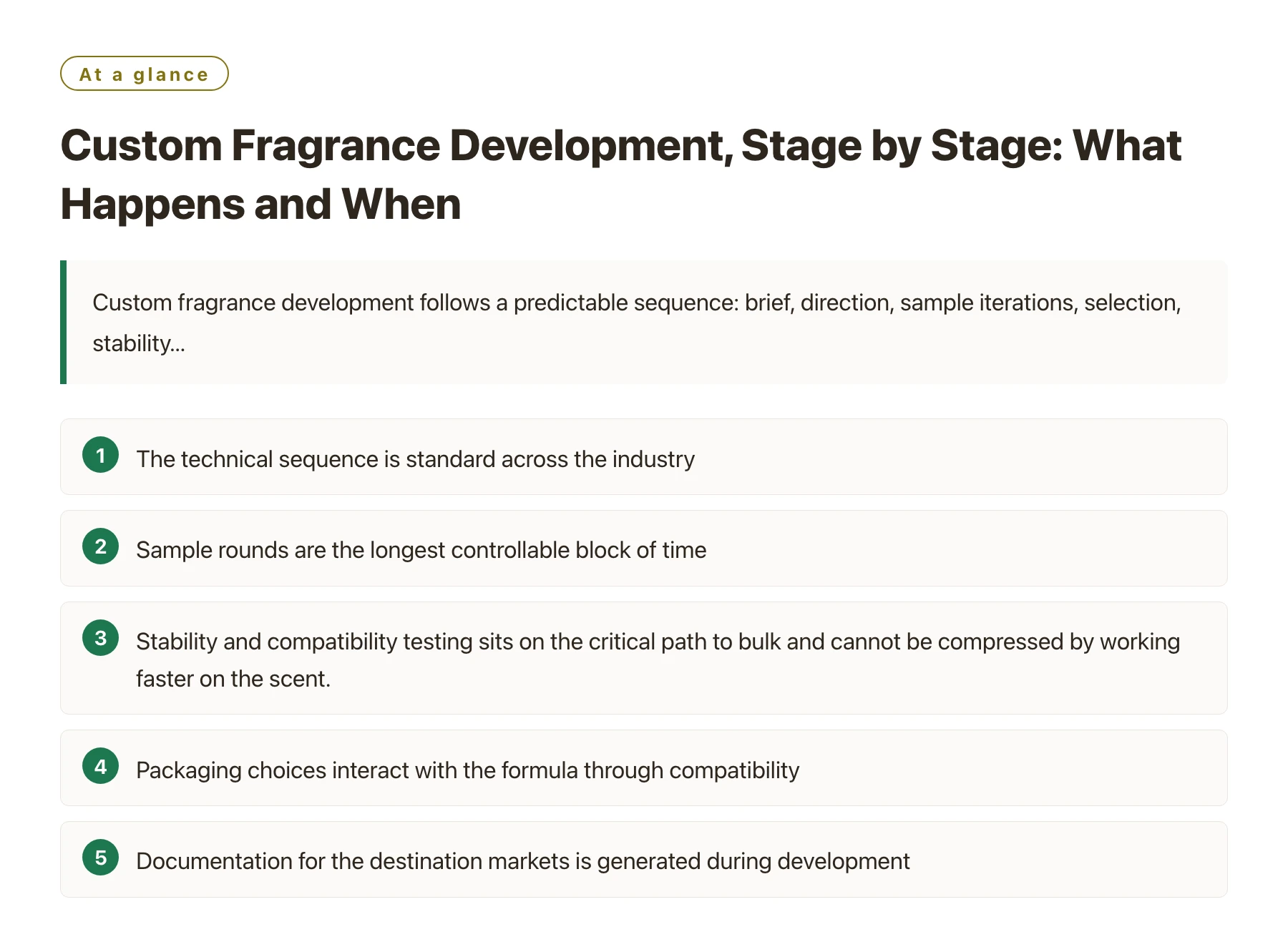
Key takeaways
- The technical sequence is standard across the industry; what differs between suppliers is how early the uncomfortable questions get asked.
- Sample rounds are the longest controllable block of time, and their length depends mainly on how clearly the brand gives feedback.
- Stability and compatibility testing sits on the critical path to bulk and cannot be compressed by working faster on the scent.
- Packaging choices interact with the formula through compatibility, so pack selection belongs in the technical sequence rather than after it.
- Documentation for the destination markets is generated during development, not after it, so the target markets need to be known early.
This article describes the process as a manufacturer runs it, in the order the work actually happens. It is written for brand teams that want to know where their own decisions sit, and how much lead time each stage genuinely needs.
Timings below are expressed as drivers rather than fixed day counts, because the same stage can take very different lengths depending on the brief, the market and the packaging.
The eight stages, and the decision each one needs
- Brief and feasibilityThe brand states market, price, volume, format and timing. The manufacturer confirms what is feasible, flags restricted materials and returns a scope, including whether the scent will be developed or adapted.
- Olfactory directionTwo or three directions are proposed, usually as simple trial blends or on-blotter sketches. The brand picks one direction, not a finished scent.
- Formula developmentThe chosen direction becomes a working formula. Restricted-material limits are applied here, because they cap how much of a given material can be used in the finished product [1].
- Sample iterationsSamples are produced, evaluated on skin and on blotter, and corrected. Each round needs structured feedback with named attributes rather than a general verdict.
- Selection and referenceOne sample is approved and retained by both parties with a date and a batch reference. This object becomes the standard the bulk run is measured against.
- Stability and compatibilityThe formula is tested over time and in contact with the chosen pack. This stage frequently forces a formula or pack adjustment, so it should not be scheduled after artwork is finalised.
- Pilot run and scale-upA small production run confirms that the approved sample can be repeated in plant conditions, including mixing and fill tolerances.
- Bulk production and releaseThe full order is compounded, filled, inspected and released against the retained reference, with batch records and the documentation the destination market requires.
Where the calendar actually goes
| Stage | What sets its length | What the brand controls |
|---|---|---|
| Brief and feasibility | How complete the brief is on the first submission | Everything - this stage is almost entirely a brand task |
| Olfactory direction | Whether the brand can choose one direction quickly | Selection speed and the quality of the reference description |
| Sample iterations | Number of rounds, and turnaround between feedback and the next trial | Feedback structure and response time |
| Stability and compatibility | Test duration required for the market and the pack | Choosing pack early enough to test against it |
| Packaging and artwork | Print, tooling and approval cycles at the brand and at the printer | Artwork approval and print sign-off |
| Pilot and bulk | Line scheduling and raw material availability | Order confirmation timing and volume accuracy |
Notice how many of these sit on the brand's side. Technical work at the factory is rarely the bottleneck; the queue of unanswered decisions usually is.
Two decisions that are cheap early and expensive late
The first is the pack. Fragrance interacts with its container: the lining of a pump, the grade of anodised aluminium, the plasticiser in a cap gasket and the seal of a roll-on all affect the liquid over time. Locking the pack before the formula is fixed lets compatibility testing run in parallel with stability work. Choosing the pack afterwards usually means a second round of both.
The second is the market. Documentation requirements differ between jurisdictions, and the regulatory framework in the destination market shapes what the product can claim and what the label has to carry. The European Commission maintains an overview of the cosmetics framework and the specific topics that apply to cosmetic products [2], and analogous lists exist for other major markets. The brand does not need to master this, but it does need to name the target markets at brief stage so the documentation set is assembled alongside the formula instead of after it.
An experienced Xuelei fragrance house tends to ask both questions before the first trial, because development and manufacturing are cheaper when the container and the market are known. A supplier that only asks about the scent is doing half the job.
What scale-up actually tests
A bench sample and a production batch differ in mixing energy, batch size and the time the liquid spends at temperature. Perfume chemistry responds to all three: some materials oxidise faster with more air contact, and some accords separate if agitation is inadequate. Testing for those effects is a routine part of cosmetics and personal care testing practice [3], and the underlying chemistry of oxidation and stability is well documented in the chemical literature [4]. The pilot run exists to find these effects at a size where they are still cheap to fix.
A simple way to hold the sequence together: build one calendar with two lanes, technical work and brand decisions, and check that no technical stage starts before its input decision is dated. Most projects that run late show a gap in the second lane that nobody noticed because both lanes looked busy.
How to keep the sequence honest
Ask for the process in writing at the quoting stage, including who owns each stage and what the outputs are. A manufacturer that can describe its own gate structure - what has to be approved before the next stage starts - is easier to plan around, and easier to hold to a date.
Then keep the two lanes visible to everyone. The single most useful artefact in a fragrance project is a one-page stage plan showing the technical sequence against the brand's decision dates, updated weekly. It makes the cost of a delayed approval obvious to the person who has to give it.
It also helps to use one partner for the whole sequence where possible. A supplier that works as a single partner from formula to finished bottle keeps one retained sample and one specification, which removes the handover failures that appear when development, filling and packaging sit with different companies. Where the process is split deliberately, the same stage plan can still be used - it just needs an owner for each handover.
Reading the published process
Most manufacturers publish a version of this sequence. Comparing two published processes against the stages of perfume production is a fast way to see whether one of them has quietly moved testing or documentation to the end, which is where schedule risk accumulates.
Sources
- IFRA Standards Library (International Fragrance Association) —— The IFRA Standards Library lists the restrictions the fragrance industry applies to individual fragrance ingredients, based on safety assessments; it is the reference point for compliant fragrance formulation.
- European Commission: Cosmetics in the EU —— The European Commission's overview of EU cosmetics rules, including the responsible person, product information file and safety report requirements.
- SGS: Cosmetics, Personal Care & Household Testing —— Testing, inspection and certification services for cosmetics and personal care, including microbiological, stability and safety testing aligned with cosmetics GMP.
- Chemistry World (Royal Society of Chemistry) —— The Royal Society of Chemistry's magazine, covering chemistry research and explanations of everyday materials including aroma compounds.
Frequently asked questions
How long does custom fragrance development take from brief to bulk?
It depends mainly on sample rounds, testing duration and packaging lead time rather than on compounding. Plan the calendar around your own approval dates and testing requirements rather than around a single quoted number of weeks.
How many samples should we expect?
Three to four rounds is normal for a new direction. Adaptation of an existing base often needs one or two. Rounds beyond that usually indicate an unresolved brief rather than a perfumery problem.
Can we shorten the process by skipping stability testing?
It is possible to reduce the scope for a low-risk product, but the decision belongs to the brand and its regulatory obligations. Testing exists to catch interactions that only appear over time, and those failures are far more expensive at retail than at development.
Does the packaging have to be chosen before the formula is finished?
It should be chosen early enough for compatibility testing to run alongside stability work. Choosing it later normally means repeating part of that testing.
What should be in the retained reference sample?
A sealed sample from a defined batch, labelled with date, batch and formula reference, held by both parties. Bulk release should be judged against it rather than against a description.