Questions Importers Can Ask About Coordinating quality checks across suppliers
When several suppliers contribute to one program, a defect at one factory can affect assembly, project timing, or the acceptance of goods from another. Buyers need a shared quality framework with common definitions and reporting, plus supplier-specific checks where processes differ. Clear ownership lets teams act quickly without confusing one supplier’s evidence with another’s.
Key takeaways
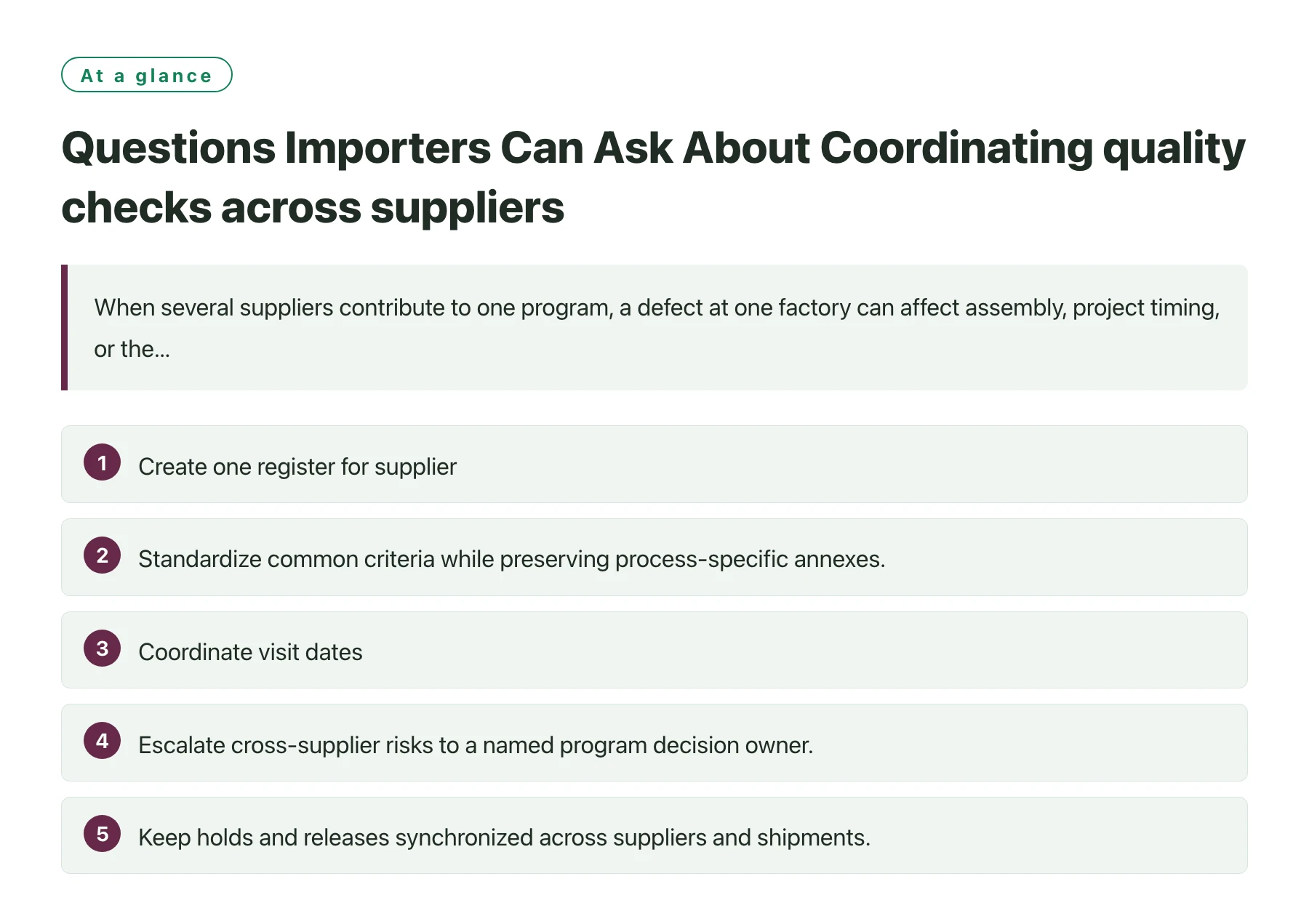
- Create one register for supplier, product, lot, risk, and open finding.
- Standardize common criteria while preserving process-specific annexes.
- Coordinate visit dates, production status, inspectors, and evidence formats.
- Escalate cross-supplier risks to a named program decision owner.
- Keep holds and releases synchronized across suppliers and shipments.
A coordinated program lets buyers compare evidence and see dependencies without applying identical controls to unlike products.
1. Map the supplier network and product relationships
List each supplier, actual production site, product or component, lot, order, process, subcontractor, and downstream dependency. Identify where components are combined or where one supplier’s delay or defect can stop another operation.
Ask who contracts, manufactures, inspects, consolidates, and releases each item. A common buyer contact does not mean each factory uses the same process or record system. Establish links between purchase orders, lots, revisions, and final assemblies.
2. Define shared quality language
Create standard definitions for critical, major, minor, pass, fail, pending, hold, concession, corrective action, and closed. Use common report fields such as product identity, revision, lot, sample basis, method, date, finding, quantity affected, and owner.
Provide a central controlled checklist and supplier-specific annexes. Keep shared expectations such as traceability and report timing consistent, while adapting technical criteria to materials, processes, and product risks. Apply revisions through a change log and confirm acknowledgement.
3. Ask how criteria are set and approved
Identify who writes specifications, selects sampling, sets limits, approves visual references, and determines shipment acceptance. Ask how the program handles conflicting drawings, market requirements, and customer instructions. Ensure technical and regulatory decisions go to qualified owners.
ISO 9001 describes quality management system requirements and process control; a certificate alone does not establish product conformity. For each supplier, ask how those controls apply to the relevant site, process, product, and lot. [1]
4. Build a coordinated inspection calendar
Track supplier readiness, sample approval, production start, critical process window, final inspection, correction time, booking cutoff, and ship date. Include dependencies such as shared inspectors, consolidated loads, common materials, and site receiving slots.
Require suppliers to report realistic readiness and quantity status. Avoid scheduling parallel visits without enough inspector capacity or technical review. Define backup dates and escalation for a supplier that is not ready so the entire program does not rely on one late status update.
5. Balance common checks and supplier-specific controls
Use shared checks for identity, revision, lot traceability, report quality, packaging marks, and corrective-action closure. Add distinct controls for each product’s critical dimensions, material, function, finish, safety, or process risk. Explain why each specialized check is included.
Avoid forcing identical sample sizes or methods onto products with different lot structures and risk. Document the basis for changes in frequency or coverage. If reducing checks for a stable supplier, define the evidence threshold and approval owner.
6. Keep evidence comparable and traceable
Use a common file naming and storage structure. Each report should identify supplier, site, order, product, revision, lot, quantity, method, criteria, inspector, results, images, and limits. Link certificates and test records to the exact model or component they cover.
Aggregate status should drill down to source evidence. A green dashboard cannot replace a lot report, and one supplier’s pass should not clear a related supplier’s uninspected goods. Maintain document access, version history, and retention across the program.
7. Coordinate cross-supplier findings
When one defect may affect shared components, instructions, or an assembled product, identify all potentially exposed lots and sites. Contain affected goods, notify relevant suppliers, compare revisions and material sources, and determine whether a broader investigation is needed.
Assign a central owner for cross-supplier risks and local owners for factory corrective actions. Keep root cause, corrective steps, verification, quantity, and due dates visible. Do not close a program-level issue because one factory corrected its own lot if the root cause may exist elsewhere.
8. Synchronize holds, concessions, and releases
Define which findings block shipment and whether a hold applies to one lot, one supplier, or a connected program scope. Specify who can approve a deviation and what evidence is required. Record expiry, affected quantity, rationale, customer approval where needed, and follow-up actions.
Keep procurement and logistics status aligned. A warehouse should not dispatch a held lot because another supplier’s goods passed. Use explicit release confirmation linked to the correct order, lot, container, and current report.
9. Compare performance with context
Review defect rates, repeat findings, response time, delivery impact, corrective-action effectiveness, and evidence completeness by supplier and product. Record inspection coverage and methods, because a supplier receiving more intensive checks may show more findings simply due to increased detection.
Compare like risks where possible and investigate outliers. Identify shared root causes such as unclear buyer specifications, common raw materials, or a consolidation process that damages goods after factory release. Use findings to revise training, criteria, frequency, or supplier support.
10. Review the coordination model after each cycle
After shipment or project closeout, ask whether suppliers received the right revisions, reports arrived in time, cross-lot risks were contained, and release status remained synchronized. Record communication gaps and ownership conflicts as corrective actions for the program process.
Buyers asking about JS Sourcing China sourcing agent can require a central register and clear program lead before work begins. Keep category-specific decisions with competent owners while maintaining one view of status, dependencies, findings, and release approvals.
Sources
Frequently asked questions
Should all suppliers have identical inspection plans?
Use common reporting and governance, then adapt technical checks and sampling to product and process risk.
Who owns a defect that may affect multiple suppliers?
Assign a central program owner to coordinate containment while each supplier owns its corrective actions.
Can one supplier’s pass release the whole consolidated shipment?
No. Release each applicable lot against its own evidence and any shared program-level holds.
How should supplier performance be compared?
Compare similar product risks and account for differences in inspection intensity, scope, and sample basis.