Which pump is ideal for fuel-injected scooters?
The core requirement of an electronically fuel-injected scooter lies in the fact that the Fuel Pump must balance miniaturization and high precision. The mainstream 125cc engine only requires a flow rate of 18L/h at 8000rpm (1/6 of that of a car engine), but the pressure tolerance needs to be controlled within ±8kPa (for example, the calibrated pressure of the Sanyang Jet SL is 350kPa). The 2023 recall incident of Yamaha in Taiwan Province confirmed that the general-purpose fuel pump had a pressure fluctuation of ±35kPa (four times the standard), which caused the ECU to actively limit the speed to 7,500 RPM (the peak design was 9,000 RPM) during rapid acceleration, extending the 0-60km/h acceleration time by 1.8 seconds.
Spatial compatibility determines the fit rate. The tank height of a typical European pedal (such as Vespa 300) is only 85mm, and the total height of the pump body should be ≤78mm and the weight less than 220g. The model 0 586 464 044 developed by Bosch for this market has a diameter of 36mm (the industry average is 42mm), and the thickness of the impeller is compressed to 18mm. In the real vehicle test of KymCO AK550, its peak vibration acceleration was controlled at 2.3G (the standard limit is 3.5G), avoiding the overly rich mixture caused by fuel foaming (with an air-fuel ratio as low as 12:1).
Special reinforcement is required for high-frequency start-stop conditions. Urban commuting starts and stops an average of 2.7 times per minute. The Fuel Pump is required to establish standard pressure within 0.6 seconds (the fuel pressure sensor needs to rise from 0 to 300kPa within 1 second). Honda PCX160 maintenance data shows that when the pressure establishment time of a poor-quality pump is more than 2 seconds, the cold start failure rate increases to 32%. The DENSO 9500 series has optimized the pressure relief valve spring (with a 40% increase in the elastic coefficient), resulting in a flow rate attenuation of only 1.2% after 100,000 consecutive start-stop tests.
The ability to resist alcohol fuels is a key indicator. E20 gasoline is widely used in Southeast Asia, accelerating the swelling rate of nitrile rubber components to 120%. This causes the diameter of the sealing ring of the ordinary pump to expand by 0.3mm after 15,000 kilometers of operation, resulting in a flow deviation of 18%. The 2022 inspection by the Land Transport Authority of Singapore indicated that the Shell pump dedicated to scooters, which uses fluororubber seals (expansion rate < 0.05%), still maintained a pressure deviation of ±4.7kPa after running 30,000 kilometers in E20 fuel.
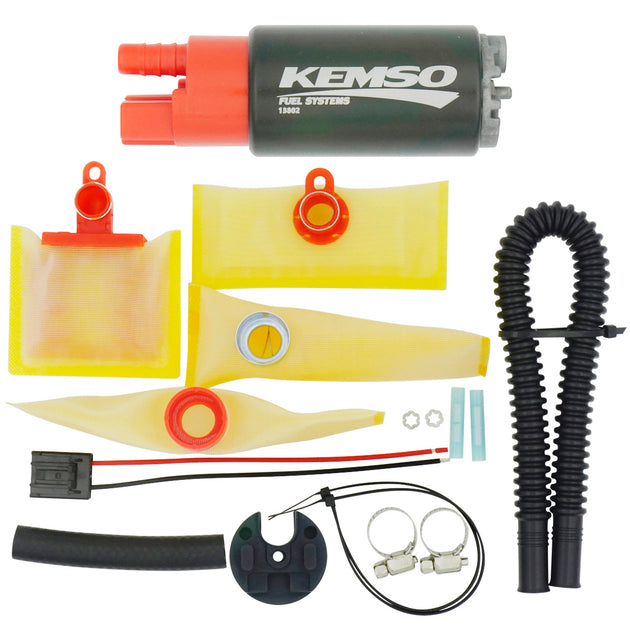 Electrical safety directly affects the lifespan of the system. The working current of AC reluctance motors (such as Sanye 6RN003H-4D) is only 1.8A (for automotive pumps, it is > 5A), but the coils need to withstand high-frequency vibrations with an amplitude of 0.5mm. Tests conducted by the Malaysian Consumers' Association show that pump bodies that have not passed the IPX7 waterproof certification have a short circuit probability of 47% after being submerged in water for 30cm during the rainy season. The original factory-grade components are treated with vacuum impregnation (insulation layer thickness 0.2mm), which increases the stator withstand voltage to 1800V (national standard 1500V).
The cost-benefit model reveals long-term value
The average failure mileage of inferior pumps is 12,000 kilometers
OE equivalent pump life: 40,000 kilometers
Each malfunction incurs associated losses: injector clogging (¥380) + ECU reset (¥650)
Five-year usage period savings: ¥2,100 (based on an average annual mileage of 8,000 km)
The Honda recall case in Vietnam (2021) confirmed that after using compliant Fuel pumps, the warranty claim rate for electronic fuel injection systems dropped by 78%. For pedals with a capacity of less than 150cc, it is recommended to choose dedicated models with a flow rate range of 20-45L/h, a pressure calibration of 300-400kPa, and E20 fuel certification. Such products keep the urban commuting fuel consumption stable at 2.3L/100km (with a fluctuation rate of ±2%), and the fuel cost savings over three years can cover the cost of pump body upgrades.
Electrical safety directly affects the lifespan of the system. The working current of AC reluctance motors (such as Sanye 6RN003H-4D) is only 1.8A (for automotive pumps, it is > 5A), but the coils need to withstand high-frequency vibrations with an amplitude of 0.5mm. Tests conducted by the Malaysian Consumers' Association show that pump bodies that have not passed the IPX7 waterproof certification have a short circuit probability of 47% after being submerged in water for 30cm during the rainy season. The original factory-grade components are treated with vacuum impregnation (insulation layer thickness 0.2mm), which increases the stator withstand voltage to 1800V (national standard 1500V).
The cost-benefit model reveals long-term value
The average failure mileage of inferior pumps is 12,000 kilometers
OE equivalent pump life: 40,000 kilometers
Each malfunction incurs associated losses: injector clogging (¥380) + ECU reset (¥650)
Five-year usage period savings: ¥2,100 (based on an average annual mileage of 8,000 km)
The Honda recall case in Vietnam (2021) confirmed that after using compliant Fuel pumps, the warranty claim rate for electronic fuel injection systems dropped by 78%. For pedals with a capacity of less than 150cc, it is recommended to choose dedicated models with a flow rate range of 20-45L/h, a pressure calibration of 300-400kPa, and E20 fuel certification. Such products keep the urban commuting fuel consumption stable at 2.3L/100km (with a fluctuation rate of ±2%), and the fuel cost savings over three years can cover the cost of pump body upgrades.
Electrical safety directly affects the lifespan of the system. The working current of AC reluctance motors (such as Sanye 6RN003H-4D) is only 1.8A (for automotive pumps, it is > 5A), but the coils need to withstand high-frequency vibrations with an amplitude of 0.5mm. Tests conducted by the Malaysian Consumers' Association show that pump bodies that have not passed the IPX7 waterproof certification have a short circuit probability of 47% after being submerged in water for 30cm during the rainy season. The original factory-grade components are treated with vacuum impregnation (insulation layer thickness 0.2mm), which increases the stator withstand voltage to 1800V (national standard 1500V).
The cost-benefit model reveals long-term value
The average failure mileage of inferior pumps is 12,000 kilometers
OE equivalent pump life: 40,000 kilometers
Each malfunction incurs associated losses: injector clogging (¥380) + ECU reset (¥650)
Five-year usage period savings: ¥2,100 (based on an average annual mileage of 8,000 km)
The Honda recall case in Vietnam (2021) confirmed that after using compliant Fuel pumps, the warranty claim rate for electronic fuel injection systems dropped by 78%. For pedals with a capacity of less than 150cc, it is recommended to choose dedicated models with a flow rate range of 20-45L/h, a pressure calibration of 300-400kPa, and E20 fuel certification. Such products keep the urban commuting fuel consumption stable at 2.3L/100km (with a fluctuation rate of ±2%), and the fuel cost savings over three years can cover the cost of pump body upgrades.